
Commercial roofing in North Charleston, SC
About Us
Who we are
Our Roofing Work
Occupied hours often decide how a roof project begins. We check the access route, loading schedule, tenant limits, and material staging before selecting a roof section for inspection. Commercial Roofing North Charleston works on low-slope and metal roofs, from a single repair detail to phased replacement. The field condition sets the scope. The property manager’s operating plan sets how that work can move.
Our work includes inspection, emergency protection, leak repair, maintenance, restoration, recover, and replacement. We perform drone and infrared moisture surveys, provide photo-supported condition reports, maintain roof records, and document information for insurance claims. A commercial roofing service plan begins with the issue and the building’s access rules, not an assumed system or predetermined solution.
How we work
Our Approach
Set the work boundary before mobilization
For an occupied property, a roof plan must connect access to the work zone below. We confirm lift placement, crew entrance, delivery windows, and areas that must remain open. The property contact supplies access rules, occupied hours, and the approval window. We label roof sections and agree on the first inspection point so facilities staff can see what will change during the visit.
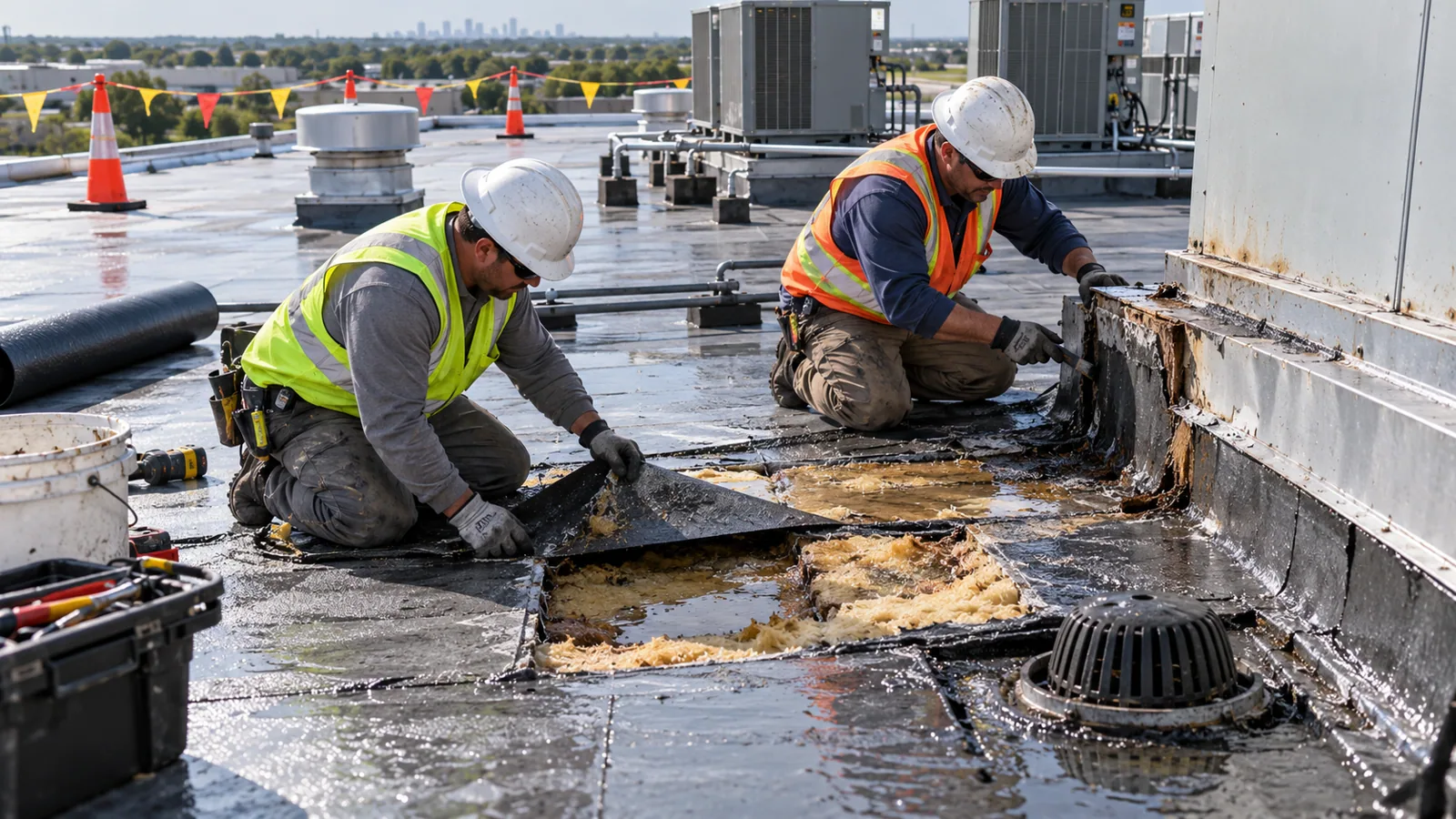
Before opening a section, we establish the dry-in boundary and how it will be protected if rain or another site condition interrupts work. If access changes, we state what is complete, what remains exposed, and which condition releases the next shift. The manager receives an update tied to a roof location and a practical decision.
Active water entry can require immediate protection. We coordinate access, protect the opening, mark the temporary work edge, and record follow-up needs. Permanent repair follows an inspection of nearby membrane, flashing, penetrations, and drainage.
Work within North Charleston’s building mix
North Charleston includes industrial, commercial, professional-office, and institutional uses. Light-industrial and technology areas extend along Cross County Road, Patriot Boulevard, Palmetto Commerce Parkway, West Montague Avenue, International Boulevard, and Southrail Drive. The property manager confirms the loading, equipment, and access limits that determine the work zone. We inspect the installed assembly and confirm loading, equipment, and access constraints with its manager.
The surrounding economy includes aerospace, advanced manufacturing, life sciences, logistics, and technology. Production work may need phasing around equipment; distribution may require a clear truck lane and off-route staging. Office and institutional uses can need a defined noise window or protection below. We confirm those limits and set the sequence.
Commercial corridors include Rivers Avenue, Dorchester Road, Ashley Phosphate Road, Remount Road, University Boulevard, and West Montague Avenue. Along Rivers Avenue or West Montague Avenue, the site entrance, roof plan, and operating rules decide access.
Inspection and records
Inspect what is installed
A stain, open lap, loose edge, or standing water is a report to investigate. We check plans and repair history, then inspect accessible seams, curbs, penetrations, flashing, drains, and perimeter details. Photos locate each finding for a later visit. The roof condition record distinguishes visible defects from questions that may need a test.
A drone roof inspection can document accessible surfaces from above. An infrared moisture survey can identify areas for further review when moisture may extend beyond a visible symptom. We explain whether a controlled opening or close inspection would change the scope.
We work with TPO, PVC, EPDM, KEE, modified bitumen, built-up, standing seam, retrofit metal, spray foam, and coating assemblies. Attachment, substrate, insulation, drainage, and transitions determine repair or renewal options. A roof system review keeps those choices tied to observed details.
Planning ahead
Plan for heat, rain, and storm context
North Charleston’s June climate normals include average highs of 88.5°F, lows of 70.4°F, and 13.5 days reaching 90°F. These readings describe the station, not roof-surface temperature. They make access hours and material handling relevant during warm periods. We still check actual site conditions and product requirements before work begins.
The local June rainfall total averages 6.21 inches, with measurable rain recorded on 12.1 days. Before tear-off or work at an open transition, we mark the stop point and define dry-in. A weather hold can move access, so the manager needs to know what is protected and what remains for a return visit.
Hugo and Debby are part of regional storm history, not proof of damage at an individual building. When a manager reports possible storm effects, we inspect for displacement, punctures, open flashing, or water entry. The record ties each finding to its location and supports the next repair or claim discussion.
Roof decisions
Choose repair, renewal, or replacement
A bounded defect may suit repair when nearby material remains sound. Repeated leaks, broad moisture, weak attachment, or deteriorated transitions may need a larger review. We explain what the inspection supports and which test could change the decision. A commercial roof repair documents a corrected detail; a restoration evaluation checks whether the assembly can accept renewal.
Recover or replacement requires review of existing layers, moisture, deck, drainage, insulation, edges, and permit requirements. For replacement, we plan tear-off, staging, transitions, and protection by section. The scope notes conditions that could change cost or timing before work expands.
Maintenance keeps drains, flashing, and seams visible between larger decisions. A preventive maintenance visit follows the property’s access needs. Roofing for different building types can carry different access needs; we confirm the property’s limits before setting the method.

Leave a record for the next crew
The closeout identifies inspected sections, completed work, open conditions, photographs, repair materials, access limits, and the next inspection point. It gives maintenance staff, ownership, and contractors a reliable handoff for a return visit.
Roof records can support budgeting, due diligence, warranty administration, and an insurance file. For a portfolio, consistent labels help compare buildings while preserving each roof’s assembly and repair history.
If equipment or access rules prevent a full inspection, we identify the roof area we could not reach and explain what access would allow the next visit to check. The manager can then decide whether to arrange equipment clearance, provide another entry window, or prioritize a separate section first.
Share roof plans, prior reports, leak history, access rules, occupied hours, and the decision window. We will identify affected sections, agree on the first check, and report findings the property team can use.
What does a first commercial roof visit include?
We confirm access and current reports, inspect visible roof details, and photograph conditions that affect the work boundary. The closeout lists findings and any additional check needed.
Can emergency protection be arranged outside business hours?
Yes. Our on-call response is available nights, weekends, and holidays. We coordinate access, protect active entry, and identify the permanent repair still required.
How do you decide whether a roof needs replacement?
We review assembly condition, moisture, attachment, deck, drainage, and repair history. The written scope explains what supports continued repair or a capital replacement decision.
What information should a property manager prepare?
Roof plans, leak locations, prior reports, access rules, occupied hours, and the approval window help establish the first sequence. We verify the rest in the field.
Talk to the team
Discuss the next roof decision
Share the building’s roof records, current concern, access rules, and operating hours. We will inspect the affected sections and return a documented sequence.